
The Dong are one of the minorities of China with a large population. According to the census of the year 2000 their population was 3,000,000 people.
They live mainly in Guizhou Province (approximately 1,800,000 people), along a fringe of flat lands that cross the province from north to south. There is also a big Dong population in the southern part of neighboring Hunan Province (about 900,000), and more than 200,000 persons in Guangxi Zhuang Autonomous Region, and a few thousand in Hubei Province (Enshi Prefecture).
The Dong, as do most of the peoples related to them, live near the rivers or in hills generally not of great height. They mainly cultivate rice. They raise domestic animals, especially hens and pigs. The exploitation of the forests, which holds a special spiritual relationship with the Dong, is an activity of economic importance.
They refer to themselves as «Kam.»
It is generally considered that there are two quite different types of Dong, the Dong of the North and the Dong of the South.
There are important linguistic and cultural differences between them. In general those of the north have received more influences from mainstream Chinese culture, while those of the south better conserve the Dong traditions. The typical monuments of the Dong, such as Drum Towers, Bridges of Rain and Wind, and the Temples of the Goddess Mother Sama, are all characteristic of the Dong of the South.
Their language belongs to the Sino-Tibetan family, Dong Dai branch, Zhuang Dong sub-branch. It has two main dialects, understandably called the northern and southern dialects, whose speakers cannot understand each other easily. Each one of these dialects has in turn three clearly differentiated local sub-dialects.
After 1958 an alphabet was invented for their language, but it has not been widely used. Before 1958, they used Chinese characters adapted to their own language.
More posts on China ethnic groups
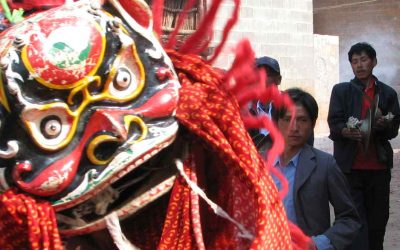
La danza del león como Danza religiosa.
LA DANZA DEL LEÓN DESCRITA POR BERTHOLD LAUFER Los bailes del león aparecieron por primera vez en China bajo la dinastía Tang (618-906 d.C.), e hicieron su debut en la corte de los reyes del Tíbet más o menos al mismo tiempo. La danza de los leones representa una...

Los Miao Floridos en Zhaotong
Los Miao Floridos en Zhaotong Como lo describe E. G. KEMP en “The Face of China”. Nueva York. 1909. Llegamos a la ciudad prefectural de Zhaotong después de pasar por una llanura sin brillo, a través de la cual soplaba un viento penetrante, característico de este...
La instrucción y los grandes exámenes a principios del siglo XX
La instrucción y los grandes exámenes En China, todos los estudios se realizan casi exclusivamente en los campos de la literatura y la historia: Si es un buen alumno, puede presentarse a los exámenes anuales, luego tomar las tres pruebas de la gran competencia trienal...
Taosi. La primera capital de China
Taosi. La primera capital de China Taosi es uno de los descubrimientos arqueológicos más importante de China en las últimas décadas. Situado en la parte sur de la provincia de Shanxi, es posiblemente el primer centro urbano surgido en China. La excavación de la...

Carácter chino 疚 jiù – enfermedad crónica.
Caracter chino 疚 jiù – enfermedad crónica 1. enfermedad crónica 2. remordimiento HSK - TRAZOS - 8 RADICAL - 疒 Elementos ---- Enfermedad 疒 + largo tiempo 久. Serie fonética 久. Enfermedad 疒 que causa dolor por mucho tiempo 久.内疚 nèijiù remordimiento (interno +...
El mito del diluvio, los chamanes y la religión Sani
El mito del diluvio, los chamanes y la religión Sani (Paul Vial. Los Lolos: Historia, religión, costumbres, lengua, escritura) Seguimos con el capítulo segundo de Los Lolos de Paul Vial, en el que llaman particularmente la atención los fragmentos dedicados al mito del...