
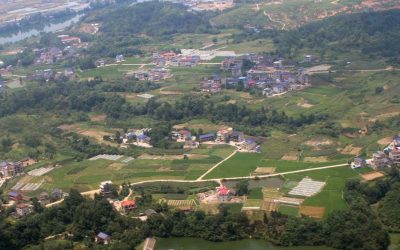
The Dong are one of the minorities of China with a large population. According to the census of the year 2000 their population was 3,000,000 people.
They live mainly in Guizhou Province (approximately 1,800,000 people), along a fringe of flat lands that cross the province from north to south. There is also a big Dong population in the southern part of neighboring Hunan Province (about 900,000), and more than 200,000 persons in Guangxi Zhuang Autonomous Region, and a few thousand in Hubei Province (Enshi Prefecture).
The Dong, as do most of the peoples related to them, live near the rivers or in hills generally not of great height. They mainly cultivate rice. They raise domestic animals, especially hens and pigs. The exploitation of the forests, which holds a special spiritual relationship with the Dong, is an activity of economic importance.
They refer to themselves as «Kam.»
It is generally considered that there are two quite different types of Dong, the Dong of the North and the Dong of the South.
There are important linguistic and cultural differences between them. In general those of the north have received more influences from mainstream Chinese culture, while those of the south better conserve the Dong traditions. The typical monuments of the Dong, such as Drum Towers, Bridges of Rain and Wind, and the Temples of the Goddess Mother Sama, are all characteristic of the Dong of the South.
Their language belongs to the Sino-Tibetan family, Dong Dai branch, Zhuang Dong sub-branch. It has two main dialects, understandably called the northern and southern dialects, whose speakers cannot understand each other easily. Each one of these dialects has in turn three clearly differentiated local sub-dialects.
After 1958 an alphabet was invented for their language, but it has not been widely used. Before 1958, they used Chinese characters adapted to their own language.
More posts on China ethnic groups

La casa de té: Un drama de Lao She
La casa de té: Un drama de Lao She En Breve: Una de las mejores obras de teatro contemporáneas obliga a múltiples reflexiones sobre la esperanza y el poder, y tal vez ese sueño universal de vivir en una sociedad justa. Un drama que se desarrolla en un espacio limitado...

Servir al pueblo, de Yan Lianke
Servir al pueblo, de Yan Lianke En Breve: Una sátira mordaz en la que se exponen los pequeños anhelos de cada persona como el sustrato inevitable sobre el que los grandes ideales, como “servir al pueblo” se construyen. La censura de una obra china es un potente...
Crónica de un vendedor de sangre de Yu Hua
Crónica de un vendedor de sangre de Yu Hua Una de las mejores novelas chinas del siglo XX. Sin la búsqueda aparente de grandes ideas, va seduciendo al lector por su sencillez, y acaba enredándole en su trama. Crónica de un vendedor de sangre, en realidad sólo es en...

El Gran Canal y la Gran Muralla
El Gran Canal y la Gran Muralla En Breve: Una breve reseña que muestra algunas de las semejanzas entre las dos obras icónicas de la historia y la cultura china, sus objetivos, y sus diferencias. Así como la forma en la que ambas acabaron por conformar este país....

Los budas decapitados del Templo Fahua en Anning
Los budas decapitados del Templo Fahua en Anning En Breve: Una de las más importantes herencias culturales de Yunnan destruida por el fundamentalismo político, una visita que invita a la reflexión. En las afueras de Kunming, la capital de Yunnan, cerca de la ciudad de...

Festival Duanwu en un templo taoísta
Festival Duanwu en un templo taoísta El pasado sábado recibí una noticia que durante la fiesta de Duanwu habría una pequeña ceremonia en el templo taoísta Zhenqing. Según la información recibida a lo largo del día se irían sucediendo diferentes actividades culturales,...