
Santasombat, Yos. Lak Chang: A Reconstruction of Tai Identity in Daikong. Canberra, AUS: Pandanus Books, 2001. p 1. (Introduction)
The Tai ethnic group, in its different branches, is beyond any doubt one of the most widespread of any ethnic group in the Southeast Asian peninsula. Different branches of the Tai are found from Assam, Vietnam and Laos to the Chinese province of Guangxi, and from Thailand to the interior of Yunnan. In Yunnan province, southern China, there are at least two major centres of the Tai civilization. One is Sipsongpanna, home of the Tai Lue in southern Yunnan, and another is Daikong, home of the Tai Yai in western Yunnan. While the Tai Lue of Sipsongpanna have been described sketchily by various students of Tai studies, little is known of the Tai Daikong in western Yunnan.
The Tai Daikong are known by various names. They call themselves «Tai Luang» or Tai Yai and in fact share remarkable cultural similarities with the Tai Yai of Shan States and the Tai Yai in Mae Hong Son province of northwest Thailand. According to Chea Yanchong, Tai Daikong refers to a particular group of Tai who settled and continued to live in the areas south (dai) of the River Kong (or Salaween). The Chinese scholars have invariably called this group «Tai Dehong», «Tai Mao», or «Tai Nua»; all these different names connote different state names or places of residence. Professor Chea further distinguished Tai Daikong into two distinct groups. The first group is called Tai Nua (northern Tai). This group of Tai Nua lives near the Burma- Chinese border, in the areas of Muang Mao, Muang Wan Teng or Wan Tieng, Muang One and Chiang Fang. Another group is called «Tai Dai» (southern Tai). The Tai Dai live in the areas of Muang Khon, Muang Ti and Muang La. These two groups of Tai Dehong share many similarities in terms of cultural traits. The spoken languages are basically the same but the written languages are mutually incomprehensible. Tai Dai uses the Tai Pong written characters of the Shan States, while the Tai Nua’s written characters resemble those of the Tai Ahom in Assam.
As if the multitude of tribe and state names (e. g. Tai Daikong, Tai Dehong, Tai Mao, Tai Nua, Tai Luang and Tai Yai) are not bewildering and confusing enough, a number of Western scholars have adopted the Burmese term «Shan» and referred to Tai Mao or Tai Daikong as «Chinese Shan», «Mao Shan», or «Shan of Yunnan». In fact, as Leach has noted, the Burmese apply the term «Shan» consistently to all the inhabitants of the Yunnan- Burma frontiers area who call themselves Tai. The Burmese usage of the term «Shan» has not been confined only to Tai Yai but also included other ethnic Tais such as Tai Lue and Tai Khun who speak different dialects.
The question, then, is who are the Tai Daikong? Postulating from the linguistic arguments, around the eighth century AD, the Tai world already extended across much of northern Southeast Asia, differentiated into five linguistic groups. The western group were ancestors of the present Tai Yai in Burma and Yunnan. By the next century, Tai-speaking chieftaincies were established on the flooded plains of the River Mao. These were believed to be Muang Mao and Pong. In the succeeding centuries, the western group of Tai-speaking people established themselves as the governing population through the Burmese Shan states, Assam and in much of Yunnan.
According to Wyatt, Tai-speaking people can be differentiated into five groups: (1) the northern group, ancestors of Zhuang; (2) Upland Tai group, ancestors of Black, Red and
White Tai; (3) Siang Kwang group, ancestors of central Thai (Siamese); (4) Lao group, ancestors of Lao and Sukhothai languages…
More posts on China ethnic groups
El poder espiritual del gallo entre los Bai
Todo viajero que ha visitado Yunnan sabe de primera mano la estrecha relación entre los gallos y las personas, pues se los ve en mercados vendidos como alimentos, protagonizando rituales de protección y sustitución de las personas y como intermediarios adecuados en...

Chinese superstitions before the birth
To have five sons, rich, vigorous, literate and who become mandarins: this is the ideal of any Chinese family. From this matrix idea emerged the various types of popular images that are displayed in all households: Wu Zi Deng Ke (五子登科), Have five official children!...
Asking about Taoism
Now is the time to ask him something about Taoism, I decided, and I poured out my questions. He looked up at me with his innocent, childish eyes, his smile gentle but, I thought, slightly ironical. 'Take time, observe and learn,' he said simply. 'Words spoken in haste...
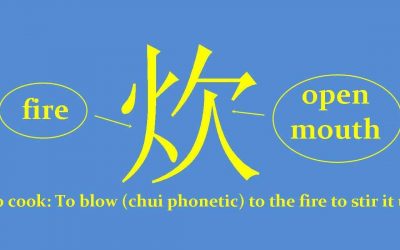
Chinese character 吹 chuī – cook
Chinese character 吹 chuī – cook ① cookHSK - STROKES - 8 RADICAL - 火 Elements ---- An open mouth 欠 + a fire 火 . Phonetic series 欠. To blow 吹 (chuī phonetic) to the fire 火 to stir it up and start cooking.炊具 chuījù cooking utensils.More posts on Chinese...
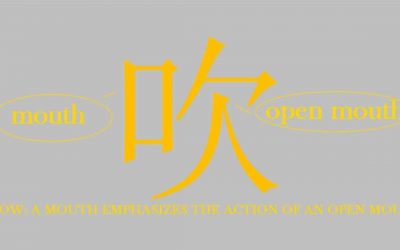
Chinese character 吹 chuī – blow, play (wind inst.)
chinese character 吹 chuī – blow, play (wind inst.) ① blow ② play (wind instruments) ③ boast, brag HSK - STROKES - 4 RADICAL - 口Elements ---- An open mouth 欠 + a mouth 口. Phonetic series 欠. An open mouth 欠 expels air 口, blowing, playing a wind instrument, or...
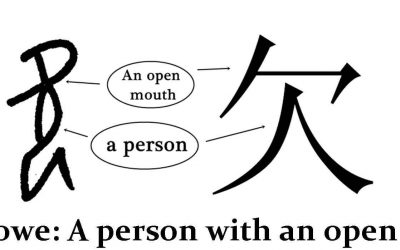
Chinese character 欠 qiàn – lack, owe
chinese character欠 qiàn – lack, owe ① lack, owe ② short of, lacking. ③ lean forwad HSK - STROKES - 4 RADICAL - 欠Elements ---- Pictogram of a person with the mouth open. Phonetic series 欠. The upper part evolved from the pictogram of an open mouth. A person人with an...