
The Dong are one of the minorities of China with a large population. According to the census of the year 2000 their population was 3,000,000 people.
They live mainly in Guizhou Province (approximately 1,800,000 people), along a fringe of flat lands that cross the province from north to south. There is also a big Dong population in the southern part of neighboring Hunan Province (about 900,000), and more than 200,000 persons in Guangxi Zhuang Autonomous Region, and a few thousand in Hubei Province (Enshi Prefecture).
The Dong, as do most of the peoples related to them, live near the rivers or in hills generally not of great height. They mainly cultivate rice. They raise domestic animals, especially hens and pigs. The exploitation of the forests, which holds a special spiritual relationship with the Dong, is an activity of economic importance.
They refer to themselves as «Kam.»
It is generally considered that there are two quite different types of Dong, the Dong of the North and the Dong of the South.
There are important linguistic and cultural differences between them. In general those of the north have received more influences from mainstream Chinese culture, while those of the south better conserve the Dong traditions. The typical monuments of the Dong, such as Drum Towers, Bridges of Rain and Wind, and the Temples of the Goddess Mother Sama, are all characteristic of the Dong of the South.
Their language belongs to the Sino-Tibetan family, Dong Dai branch, Zhuang Dong sub-branch. It has two main dialects, understandably called the northern and southern dialects, whose speakers cannot understand each other easily. Each one of these dialects has in turn three clearly differentiated local sub-dialects.
After 1958 an alphabet was invented for their language, but it has not been widely used. Before 1958, they used Chinese characters adapted to their own language.
More posts on China ethnic groups
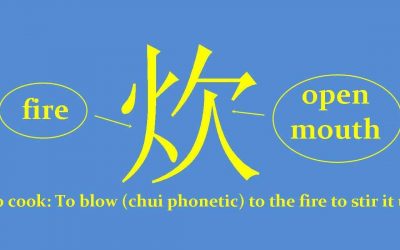
Chinese character 吹 chuī – cook
Chinese character 吹 chuī – cook ① cookHSK - STROKES - 8 RADICAL - 火 Elements ---- An open mouth 欠 + a fire 火 . Phonetic series 欠. To blow 吹 (chuī phonetic) to the fire 火 to stir it up and start cooking.炊具 chuījù cooking utensils.More posts on Chinese...
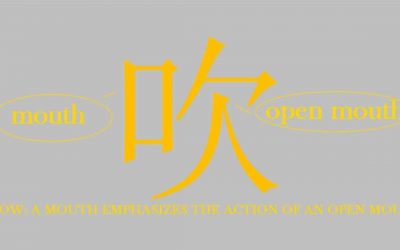
Chinese character 吹 chuī – blow, play (wind inst.)
chinese character 吹 chuī – blow, play (wind inst.) ① blow ② play (wind instruments) ③ boast, brag HSK - STROKES - 4 RADICAL - 口Elements ---- An open mouth 欠 + a mouth 口. Phonetic series 欠. An open mouth 欠 expels air 口, blowing, playing a wind instrument, or...
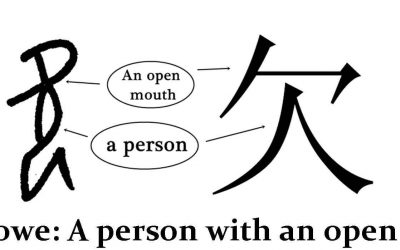
Chinese character 欠 qiàn – lack, owe
chinese character欠 qiàn – lack, owe ① lack, owe ② short of, lacking. ③ lean forwad HSK - STROKES - 4 RADICAL - 欠Elements ---- Pictogram of a person with the mouth open. Phonetic series 欠. The upper part evolved from the pictogram of an open mouth. A person人with an...
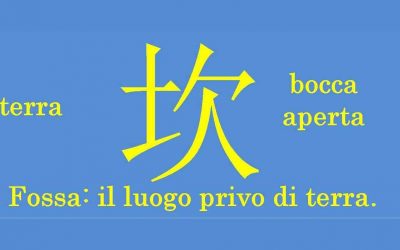
Caratteri cinesi 坎 kǎn – fossa
Caratteri cinesi 坎 kǎn – fossa fossa, buca cresta HSK - tratti - 7 RADICALe - 土 Un pittogramma di un buco nella terra: il luogo privo 欠 di terra 土. 垄坎 lǒngkǎn crinale tra i campi. Altri post sui caratteri cinesi
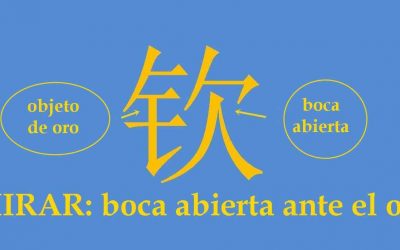
Caracter chino 钦 qīn – admirar
Caracter chino 钦 qīn – admirar 1. admirar 2. respetar. HSK - TRAZOS - 10 RADICAL - 钅Elementos ---- Boca abierta 欠 + metal 钅. Serie fonética 欠. Con la boca abierta 欠 ante un objeto metálico 钅 (jīn fonético) o dorado. 钦慕 qīnmù - admirar, respetar. Más sobre los...

Chinese character 坎 kǎn – pit, hole
Chinese character 坎 kǎn – pit, hole 1. pit, hole 2. bank (of river) 3 ridge HSK - STROKES - 7 RADICAL - 土Elements ---- Open mouth 欠 + earth 土. Phonetic series 欠. A pictogram of a hole in the earth: the place lacking 欠 earth 土.垄坎 lǒngkǎn ridge between fields.In OBC...