
The Dong are one of the minorities of China with a large population. According to the census of the year 2000 their population was 3,000,000 people.
They live mainly in Guizhou Province (approximately 1,800,000 people), along a fringe of flat lands that cross the province from north to south. There is also a big Dong population in the southern part of neighboring Hunan Province (about 900,000), and more than 200,000 persons in Guangxi Zhuang Autonomous Region, and a few thousand in Hubei Province (Enshi Prefecture).
The Dong, as do most of the peoples related to them, live near the rivers or in hills generally not of great height. They mainly cultivate rice. They raise domestic animals, especially hens and pigs. The exploitation of the forests, which holds a special spiritual relationship with the Dong, is an activity of economic importance.
They refer to themselves as «Kam.»
It is generally considered that there are two quite different types of Dong, the Dong of the North and the Dong of the South.
There are important linguistic and cultural differences between them. In general those of the north have received more influences from mainstream Chinese culture, while those of the south better conserve the Dong traditions. The typical monuments of the Dong, such as Drum Towers, Bridges of Rain and Wind, and the Temples of the Goddess Mother Sama, are all characteristic of the Dong of the South.
Their language belongs to the Sino-Tibetan family, Dong Dai branch, Zhuang Dong sub-branch. It has two main dialects, understandably called the northern and southern dialects, whose speakers cannot understand each other easily. Each one of these dialects has in turn three clearly differentiated local sub-dialects.
After 1958 an alphabet was invented for their language, but it has not been widely used. Before 1958, they used Chinese characters adapted to their own language.
More posts on China ethnic groups

La Cabra en el horóscopo chino
La Cabra en el horóscopo chino La cabra y la oveja se confunden en la simbología de la cultura china, pues amabas se escriben con el carácter Yang 羊 , especificándose que la oveja da lana (绵羊) y la cabra vive en la montaña (山羊), en general ambas tienen un carácter...

El Cerdo en el Horóscopo chino
El Cerdo en el horóscopo chino El cerdo en la cultura china es un carácter ambiguo. Se le ve gordo y feo, alimentándose de las cosas más sucias, pero al mismo tiempo, su carne es la más apetitosa para los chinos. Su carne es "carne" en general, como arquetipo de carne...

El Dragón en el Horóscopo chino
El Dragón en el Horóscopo chino El dragón es el único de los animales del Horóscopo chino que sólo tiene una existencia imaginaria, y de hecho en el horóscopo de otros pueblos indígenas de China, es sustituido por otro animal. Aunque el dragón es animal imaginario,...

El Gallo en el horóscopo chino
El Gallo en el horóscopo chino En la cultura china, como en otras muchas, el gallo está estrechamente asociado al sol. En algunos mitos sólo se encarga de llamar al sol para que salga cada mañana, tarea en la que otros animales han fracasado, en otros el gallo es un...
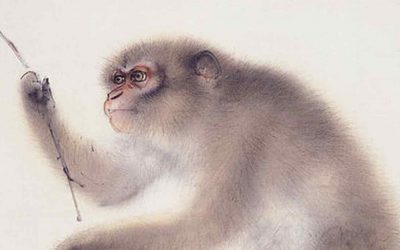
El Mono en el Horóscopo chino
El Mono en el Horóscopo chino En la cultura china el mono tiene un papel calcado del que Darwin le otorga en la escala evolutiva. Como hermano menor del hombre, participa en muchas de sus cualidades, además, en muchas ocasiones disfruta de la capacidad de...

El Perro en el zodiaco chino
El Perro en el zodiaco chino El perro es uno de los animales más importantes en la cultura china, y es el primero de los animales domésticos que acompañó a los antepasados de los chinos en sus actividades por la tierra. Desde muy pronto tuvo un papel decisivo en la...