

Pedro Ceinos-Arcones. China’s last but one matriarchy: The Jino of Yunnan. 2018
Jinuos’ main religious specialists are bailabao, mopei and zhalai or Blacksmith. The oldest man of the main clan in the village is called zhuoba or mother of the village; the oldest of the second clan is the zhuosheng or father of the village. They have as leader of the village, important ritual functions, presiding over the most important ceremonies and rituals. The oldest woman in the village, called youka, also has some ritual functions. It is possible that in the past most of the clan leaders were women and maybe shamans: the wisest shamans that could divine omens and chant incantations, as they are credited with the first improvements in human civilization.
They believe the power held nowadays by the religious specialists is a heritage of that of the legendary shamanesses, and, as the spiritual power belongs to women, they must feminize themselves. Sometimes when male shamans conduct rituals, they are required to dress as women, or they need to get married symbolically to a goddess.
While the zhuoba and zhuosheng are ritual leaders, bailapao and mopei are associated with shamans. Both bailapao and mopei were hereditary posts (Cheng 1993). Ironsmiths, priests and shamans, due to their dependence on the goddesses, must ritually marry one. From the moment when the love for the goddess is manifested to the time when the ritual wedding is celebrated there are certain steps.
The start is a casual encounter with the goddess who is looking for a representative on earth; usually a strange thing happens that only can be explained for as divine intervention, such as appearing and disappearing of shellfish, which is considered a sign that the goddess of the shellfish is playing with him. Then they ask an old bailapao to divine if the person that suffered this experience has really been before the goddess. To do it he must perform a ceremony for the goddess of shellfish with offerings of pigs and other animals, and must even sacrifice a cow. Before the sacrifice of a cow a very important ceremony is performed, when the old bailapao, before an improvised altar, produces two shellfish enacting the ritual marriage between the new bailapao and the goddess of the shellfish. If the result is positive they must inform the chief of the village, who would advise him about a ritual marriage, in which he would act as witness. Then they must build a house for the bride goddess in the groom’s home, which a size of 30 cm high. Inside it they put a nuptial bed. Then they chose an auspicious date and celebrate the proper wedding, sacrificing a cow. Under the sound of drums and cymbals, the old shaman helps the groom to go near the goddess, doing some magic tricks to make her presence known to everybody. At the end they invite the goddess to go live in the new house, and from then on they consider that this man has two wives: the goddess and his mortal wife.
After this ceremony the old bailapao would instruct the new one during some time until the moment when he can perform ceremonies by himself. Later he will build his own altar to the shellfish goddess, consisting of a wood panel with many shellfish hanging from it, and he would place his divination objects below the altar, and make his ritual dress black color and a ritual cap of the same color, decorated with strips of many colors and with many shellfish hanging. His ritual implements include two ritual swords, a female one used inside the house, and a male one to be used outside, a pole and a paper fan, that are usually kept on the altar (Cheng 1993).
More posts on China ethnic groups
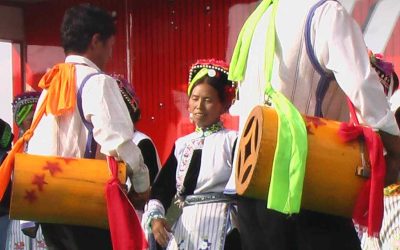
El mito del diluvio, los chamanes y la religión Sani
El mito del diluvio, los chamanes y la religión Sani (Paul Vial. Los Lolos: Historia, religión, costumbres, lengua, escritura) Seguimos con el capítulo segundo de Los Lolos de Paul Vial, en el que llaman particularmente la atención los fragmentos dedicados al mito del...
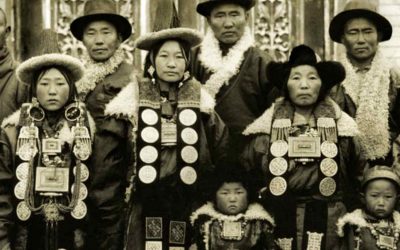
Hubo un matriarcado entre los Yugur?
Hubo un matriarcado entre los Yugur? Las costumbres matrimoniales de los Yugur presentan diferencias entre sus dos grupos principales. Entre los Yugur orientales las muchachas disponían de una época de gran libertad sexual. Su rito de paso era la ceremonia de hacerse...
Los Yugur de Gansu, descendientes de los Reyes de Dunhuang
Los Yugur de Gansu, descendientes de los Reyes de Dunhuang Denominación. Su nombre chino es Yugu, escrito 裕 固 族. Los Yugu o Yugur se llaman a sí mismos Yaoyuer y Xilayuguer. La denominación Yugur es relativamente reciente, pues solo empezó a utilizarse después del...

¿Quién es esa Diosa del Cielo que suelta flores?
¿Quién es esa Diosa del Cielo que suelta flores? Cuando llegamos a un país con una cultura tan distinta como la China es como si un manto de niebla nos cubriera los ojos, permitiéndonos solo una visión borrosa de todo lo que nos rodea. Luego vamos reconociendo los...
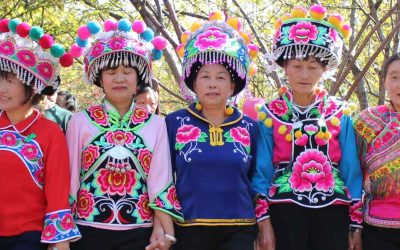
¿Por qué tienes que visitar un parque chino?
¿Por qué tienes que visitar un parque chino? Si muchos de los que viajan a China tienen la tendencia de visitar un mercado pensando que allí se concentra la esencia de la cultura del pueblo, esa visita debe de ser complementada con la de un parque, uno grande si es...
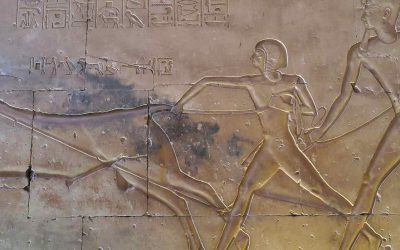
Bye Bye Darwin, el toro y el perro diseñaron las sociedades humanas
Bye Bye Darwin, el toro y el perro diseñaron las sociedades humanas Los toros salvajes, los llamados uros ya desaparecidos, eran el mamífero más grande que se podía encontrar en muchas de las regiones templadas del continente Euroasiático, uno de los más peligrosos,...