
The Dong are one of the minorities of China with a large population. According to the census of the year 2000 their population was 3,000,000 people.
They live mainly in Guizhou Province (approximately 1,800,000 people), along a fringe of flat lands that cross the province from north to south. There is also a big Dong population in the southern part of neighboring Hunan Province (about 900,000), and more than 200,000 persons in Guangxi Zhuang Autonomous Region, and a few thousand in Hubei Province (Enshi Prefecture).
The Dong, as do most of the peoples related to them, live near the rivers or in hills generally not of great height. They mainly cultivate rice. They raise domestic animals, especially hens and pigs. The exploitation of the forests, which holds a special spiritual relationship with the Dong, is an activity of economic importance.
They refer to themselves as «Kam.»
It is generally considered that there are two quite different types of Dong, the Dong of the North and the Dong of the South.
There are important linguistic and cultural differences between them. In general those of the north have received more influences from mainstream Chinese culture, while those of the south better conserve the Dong traditions. The typical monuments of the Dong, such as Drum Towers, Bridges of Rain and Wind, and the Temples of the Goddess Mother Sama, are all characteristic of the Dong of the South.
Their language belongs to the Sino-Tibetan family, Dong Dai branch, Zhuang Dong sub-branch. It has two main dialects, understandably called the northern and southern dialects, whose speakers cannot understand each other easily. Each one of these dialects has in turn three clearly differentiated local sub-dialects.
After 1958 an alphabet was invented for their language, but it has not been widely used. Before 1958, they used Chinese characters adapted to their own language.
More posts on China ethnic groups
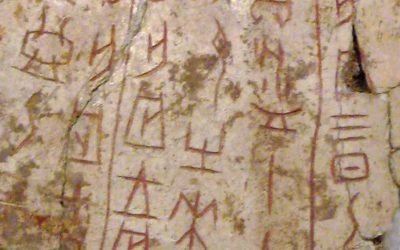
El origen de los caracteres chinos
Interesante teoría sobre el origen de los caracteres chinos en el libro John C. Didier, “In and Outside the Square,” Sino-Platonic Papers, 192, vol. 1 (September, 2009). Pag.71. La tecnología de la escritura aparece súbita y morfológicamente plenamente desarrollada en...
The origin of Chinese characters
The origin of Chinese characters in John C. Didier, “In and Outside the Square,” Sino-Platonic Papers, 192, vol. 1 (September, 2009) The technology of writing appears suddenly and morphologically fully developed on Shang oracle bones and, later, bronzes at about the...
Caractère chinois 满 mǎn – plein
More posts on Chinese characters

Caractère chinois 辆 lliàng – quantificateur
More posts on Chinese characters
Caractère chinois 两 liǎng – deux
More posts on Chinese characters
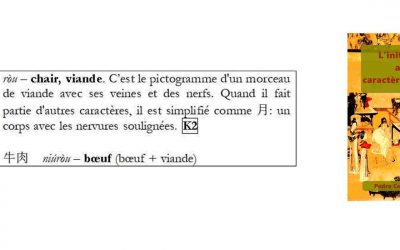
Caractère chinois 肉 ròu – chair
More posts on Chinese characters