
Chinese character 次 second, times
- second
- times, order
- inferior
- remain
- stand.
HSK – 2
STROKES – 6
RADICAL – 冫
Elements —- two 二 + open mouth 欠. Phonetic series 次.
This is two 二 breaths (or two sneezes) with an open mouth 欠, emphasizing the second one. Second > secondary > times > order > arrange > arrange hair (of woman). It is also the modern form of an OBC that showed a military encampment > place > remain > stand.
其次 qícì – next; second.
次序 cìxù – order, sequence (order + order)
Two breaths to mean second, for the second breath. First and second give the idea of counting > order. It also give the meaning of times, once, twice….
From second we have also the idea of something of second category, then inferior. Something of inferior category remains in a place, nobody want to take it. From remain > stand (a person who remains). Stand is rarely used but important to understand other characters of this family.
More posts on Chinese characters
El origen de los caracteres chinos
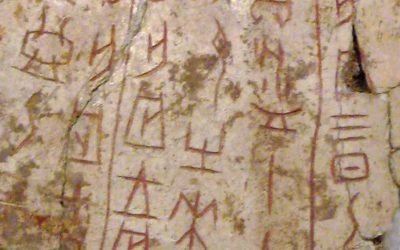
Interesante teoría sobre el origen de los caracteres chinos en el libro John C. Didier, “In and Outside the Square,” Sino-Platonic Papers, 192, vol. 1 (September, 2009). Pag.71. La tecnología de la escritura aparece súbita y morfológicamente plenamente desarrollada en...
The origin of Chinese characters
The origin of Chinese characters in John C. Didier, “In and Outside the Square,” Sino-Platonic Papers, 192, vol. 1 (September, 2009) The technology of writing appears suddenly and morphologically fully developed on Shang oracle bones and, later, bronzes at about the...
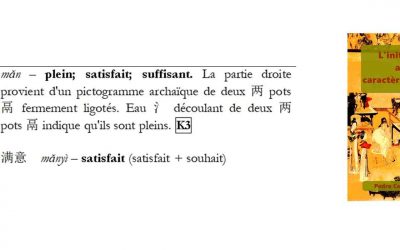
Caractère chinois 满 mǎn – plein
More posts on Chinese characters

Caractère chinois 辆 lliàng – quantificateur
More posts on Chinese characters
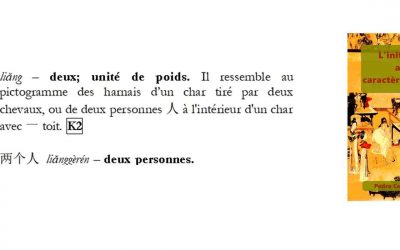
Caractère chinois 两 liǎng – deux
More posts on Chinese characters
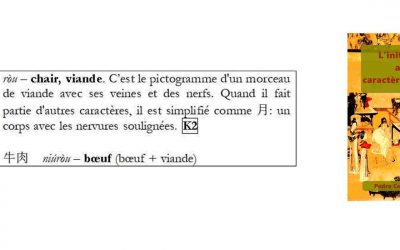
Caractère chinois 肉 ròu – chair
More posts on Chinese characters