
The rituals performed at birth suggest that in the Naxi traditional thought the entering of the Sv life god in a person is a gradual process developed during the last term of pregnancy and the first days of life, and that this process is considered complete in a first phase, when the new born is one month old[1]. Before this time, lacking the protection of the Sv life god, mother and child, considered especially vulnerable, are carefully protected and object of some taboos, with the mother usually fed with chicken soup and eggs, not being allowed to bathe or wash her hair, nor to go out of her courtyard (Pinso 2006: 150).
In Baidi, where the traditions are better preserved, when a woman gets pregnant she avoids those tasks requiring more physical effort. As she is considered unclean, she must observe different taboos. In the time of delivery she is assisted by the two future grandmothers who would take the newborn once he is born, cut the umbilical cord with scissors, and wrap his belly with a cotton cloth. The placenta is wrapped in vegetal paper and put in a jug, then buried near a tree or in a not much trodden place, with the umbilical end facing up, lest the baby will suffer from nightmares.
If during this process some problems appear, the members of the family will pray to the gods and ancestors to protect mother and child. Three small stones are hung on the main door of the house to let the people know that a child has been born, as nobody can visit this home at night. In some villages the same day of birth a Dongba is called to perform the ritual of getting rid of the dirtiness. To do it, he will carve a horse with wood of black willow and a puppet with eyes, mouth, and nose with a branch of red willow, as well as some magical implements to expel the evil spirits. He will put all these things in a basket near the heaven prop, and will read some chants to purify the house.
The climax of the ceremony is when the Dongba, after sprinkling water on every member of the family, sprinkle some water on the body of a chicken, which is immediately sacrificed, symbolizing that it will take away all the impurities of the family (Yang 2008). It is interesting to remark the presence of the horse both in the first moments of life and in the last ones, and to remember its role as a spiritual carrier in shamanistic religions. In villages around the Lijiang plain the third day after birth a Dongba is invited to worship the God Sanduo with a chicken or a pig for giving a name to the newborn.
The first month of life is a time of important spiritual adjustments, as shown in the tradition that prescribes that until the newborn reaches one month, the members of the family would burn incense and pray the gods and ancestors every day. When he is one month old, the mother would wash her hair and would invite a Dongba to celebrate a simple ceremony of Guide the child to go out, when the Dongba sings his prayers opening the road and the mother follows him with the child at her back. A ceremony with an interesting parallelism with this other performed after death, when the Dongba would open the road again, this time to the ancestors’ realm.
The child must have a needle inserted in his cap and a little sickle hanging from his neck, to avoid the attack of evil spirits. After opening the road they can go back home, where friends and relatives would present the new-born with baba, rice and pork, and the Dongba would choose a name that must be related in a magical way to the age and horoscope of his mother (He Shaoying 2001: 166-170). The fact that the baby isn’t called by his name until he is one month old shows that the Naxi think he is not a person until this age, possibly because this is the time the Sv god needs to enter his body.
Children are usually breastfed until they reach one year old, when their milk is officially stopped, though sometimes it goes on for some months. To stop the baby from drinking milk they have some methods, as separating mother and child during one week, smearing the mother breasts with pork bile, or drawing dreadful designs on the mother’s breast. Then the child is fed three times every day with corn porridge. During the first year of life the babies are not washed (He Shaoying 2001: 166-170).
This fragment is part of Ceinos-Arcones, Pedro. Sons of Heaven, Brothers of Nature – The Naxi of Southwest China.
More posts on China ethnic groups

Kashgar, la joya de la Ruta de la Seda
Kashgar, la joya de la Ruta de la Seda Los que preparan un viaje a la Ruta de la Seda china de repente descubren que entre los lugares recomendados, hay uno a considerable distancia de todos los demás. Es la ciudad de Kashgar y todo aquel que realizara un viaje...
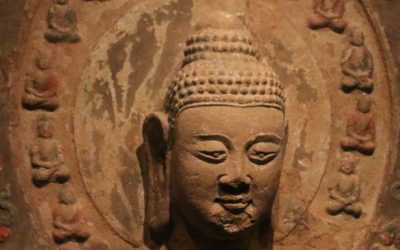
La escultura budista más bella de Beijing
La escultura budista más bella de Beijing Es la “Escultura de piedra del Buda Sakyamuni con dos guardianes”, que se encuentra en el Museo de la Capital de Beijing. Está fechada en la Dinastía Wei del Norte, en el 23º año del Emperador Taihe (año 499 de nuestra era)...
Literatura china: autores y obras más importantes
La tradición literaria de China no es de las más antiguas del mundo. Es superada en miles de años por las del Cercano Oriente y la de Egipto. Sin embargo se puede afirmar que es la tradición literaria que puede presumir de mayor continuidad a lo largo de la historia....

Caracter chino 久 jiǔ – largo tiempo.
Caracter chino 久 jiǔ – largo tiempo 1. largo tiempo 2. duradero HSK - 3 TRAZOS - 3 RADICAL -丿 Elementos ---- Pictograma de persona modificada. Serie fonética 久. Pictograma de una persona 人 = ⺈ con algo en su pierna, tal vez una cadena que le obliga a caminar...
Violencia y canibalismo en las Cinco Dinastías
Violencia y canibalismo en las Cinco Dinastías Cuando uno empieza a conocer la historia de China concentra sus lecturas en los momentos culminantes de la misma, en esas grandes dinastías que expandieron el territorio, recrearon sorprendentes formas culturales y se...
Puliendo y frotando para crear el mundo entre los Wa de China
La creación del mundo entre los Wa de China Apenas se hubo terminado de formar el cielo, parecía la espalda de un sapo, llena de bultos y salientes, era muy feo. El dios Li[1] extendió sus manos y estuvo puliendo sin parar. Nadie sabe cuántos años estuvo puliendo,...