
Now is the time to ask him something about Taoism, I decided, and I poured out my questions. He looked up at me with his innocent, childish eyes, his smile gentle but, I thought, slightly ironical.
‘Take time, observe and learn,’ he said simply. ‘Words spoken in haste will not stick; a cup of water splashed into a parched field will do it no good. It is only a slow and gentle rain that will saturate the soil and produce life.’ He became silent ready to resume his work.
His rebuke abashed me. I saw what he meant. He probably thought I was an idle tourist, or worse, a young writer, who wanted to learn something about Taoism in an hour or so, and then write a smart article, boasting of the mysteries revealed to him. Seeing my obvious confusion, the old man relented. His face was all smiles now, but his eyes became thoughtful.
‘If you want to learn about the Eternal Tao, do not be casual and in a hurry. Don’t glean too much from too many books, for each book is full of opinions, prejudices and corruptions.
Read only one book and only one—our Old Master’s Taoteking, and then try to understand it, not by juggling the words and meanings, but intuitively, through your heart and spirit. Don’t ask too many questions, but patiently watch what we Taoists do, and perceive the hidden motives of our actions, and not that which is only for display.
Do not be guided so much by your intellect as by faith, love and your heart, which is another name for understanding and compassion. What you need is wisdom, and not knowledge; for if one has wisdom, knowledge will come naturally. Always remember that the Eternal Tao is Infinite Wisdom, Infinite Love and Infinite Simplicity.’ And with this the old man took up his pickaxe and resumed his hoeing of the bush.
From: Peter Goullart. The monastery of Jade Mountain. 1961
More posts on Chinese culture
Caractère chinois 肉 ròu – chair
More posts on Chinese characters
Caractère chinois 认 rèn – connaître
More posts on Chinese characters
Caractère chinois 人 rén – personne
More posts on Chinese characters

Familia de caracteres 欠 bostezar, boca abierta.
欠 qiàn – bostezar; deber; faltar, carecer. La parte superior evolucionó desde el pictograma de una boca abierta. Una persona 人 con la boca abierta está bostezando o trata de combatir la falta de aire. 欠缺 qiànquē – falta, deficiencia (faltar + faltar) 欠债 ...

Caracter chino 欠 qiàn – bostezar
Caracter chino 欠 qiàn – bostezar 1. bostezar 2. deber 3. faltar 4. carecer. HSK - 6 TRAZOS - 4 RADICAL - 欠 Elementos ---- Pictograma de una persona con la boca abierta. Serie fonética 欠. La parte superior evolucionó desde el pictograma de una boca abierta. Una...
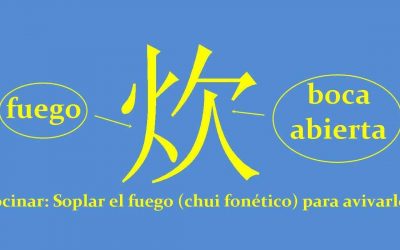
Caracter chino 炊 chuī – cocinar
Caracter chino 炊 chuī – cocinar 1. cocinar 2. cocer. HSK - TRAZOS - 8 RADICAL - 火Elementos ---- Boca abierta 欠 + fuego 火. Serie fonética 欠. Soplar 吹 (chuī fonético) al fuego 火 para avivarlo y empezar a cocinar.炊具 chuījù - utensilios de cocina. More posts on...
More posts on China ethnic groups
Caractère chinois 肉 ròu – chair
More posts on Chinese characters
Caractère chinois 认 rèn – connaître
More posts on Chinese characters
Caractère chinois 人 rén – personne
More posts on Chinese characters
Familia de caracteres 欠 bostezar, boca abierta.
欠 qiàn – bostezar; deber; faltar, carecer. La parte superior evolucionó desde el pictograma de una boca abierta. Una persona 人 con la boca abierta está bostezando o trata de combatir la falta de aire. 欠缺 qiànquē – falta, deficiencia (faltar + faltar) 欠债 ...
Caracter chino 欠 qiàn – bostezar
Caracter chino 欠 qiàn – bostezar 1. bostezar 2. deber 3. faltar 4. carecer. HSK - 6 TRAZOS - 4 RADICAL - 欠 Elementos ---- Pictograma de una persona con la boca abierta. Serie fonética 欠. La parte superior evolucionó desde el pictograma de una boca abierta. Una...
Caracter chino 炊 chuī – cocinar
Caracter chino 炊 chuī – cocinar 1. cocinar 2. cocer. HSK - TRAZOS - 8 RADICAL - 火Elementos ---- Boca abierta 欠 + fuego 火. Serie fonética 欠. Soplar 吹 (chuī fonético) al fuego 火 para avivarlo y empezar a cocinar.炊具 chuījù - utensilios de cocina. More posts on...